Before you begin reading the Bible it can be helpful to consider the timeline of its writing.
There are debates about many of these dates, but this summary will help gain an understanding of when the books were written.
The following timeline may be helpful in understanding the period of time over which the books of the Bible are believed to be written.
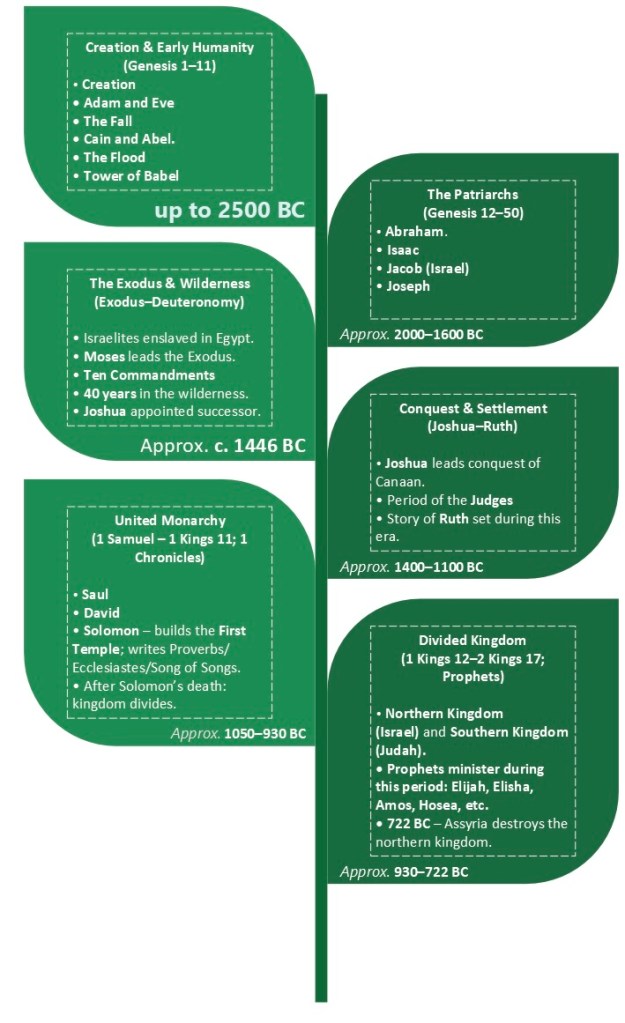
1. Creation & Early Humanity (Genesis 1–11)
• Creation – God creates the world (Genesis 1–2).
• Adam and Eve – Garden of Eden.
• The Fall – Entry of sin into the world.
• Cain and Abel.
• The Flood – Noah’s Ark (traditionally placed c. 3000–2500 BC or earlier).
• Tower of Babel – Humanity scatters.
2. The Patriarchs (Genesis 12–50)
Approx. 2000–1600 BC
• Abraham called by God; covenant established.
• Isaac – child of promise.
• Jacob (Israel) – father of the twelve tribes.
• Joseph – sold into Egypt; his family later joins him there.
3. The Exodus & Wilderness (Exodus–Deuteronomy)
Approx. c. 1446 BC (traditional date) or c. 1270 BC (alternative)
• Israelites enslaved in Egypt.
• Moses leads the Exodus.
• Ten Commandments at Mount Sinai.
• 40 years in the wilderness.
• Joshua appointed successor.
4. Conquest & Settlement (Joshua–Ruth)
Approx. 1400–1100 BC
• Joshua leads conquest of Canaan.
• Period of the Judges (including Deborah, Gideon, Samson).
• Story of Ruth set during this era.
5. United Monarchy (1 Samuel – 1 Kings 11; 1 Chronicles)
Approx. 1050–930 BC
• Saul – first king of Israel.
• David – expands the kingdom; writes many Psalms.
• Solomon – builds the First Temple; writes Proverbs/Ecclesiastes/Song of Songs.
• After Solomon’s death: kingdom divides.
6. Divided Kingdom (1 Kings 12–2 Kings 17; Prophets)
Approx. 930–722 BC
• Northern Kingdom (Israel) and Southern Kingdom (Judah).
• Prophets minister during this period: Elijah, Elisha, Amos, Hosea, etc.
• 722 BC – Assyria destroys the northern kingdom.
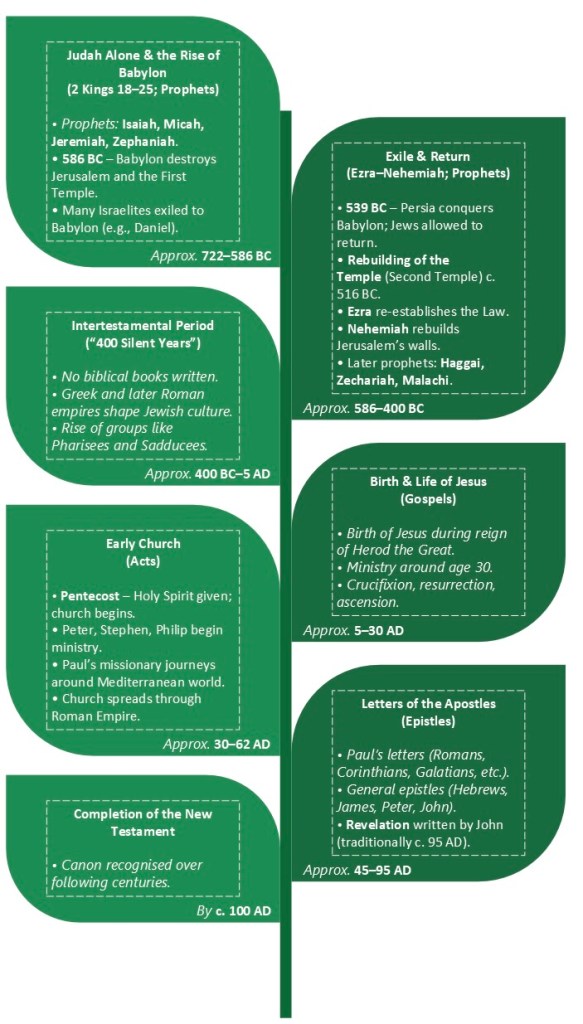
7. Judah Alone & the Rise of Babylon (2 Kings 18–25; Prophets)
Approx. 722–586 BC
• Prophets: Isaiah, Micah, Jeremiah, Zephaniah.
• 586 BC – Babylon destroys Jerusalem and the First Temple.
• Many Israelites exiled to Babylon (e.g., Daniel).
8. Exile & Return (Ezra–Nehemiah; Prophets)
Approx. 586–400 BC
• 539 BC – Persia conquers Babylon; Jews allowed to return.
• Rebuilding of the Temple (Second Temple) c. 516 BC.
• Ezra re-establishes the Law.
• Nehemiah rebuilds Jerusalem’s walls.
• Later prophets: Haggai, Zechariah, Malachi.
9. Intertestamental Period (“400 Silent Years”)
Approx. 400–5 BC
• No biblical books written.
• Greek and later Roman empires shape Jewish culture.
• Rise of groups like Pharisees and Sadducees.
10. Birth & Life of Jesus (Gospels)
Approx. 5–30 AD
• Birth of Jesus during reign of Herod the Great.
• Ministry around age 30.
• Crucifixion, resurrection, ascension.
11. Early Church (Acts)
Approx. 30–62 AD
• Pentecost – Holy Spirit given; church begins.
• Peter, Stephen, Philip begin ministry.
• Paul’s missionary journeys around Mediterranean world.
• Church spreads through Roman Empire.
12. Letters of the Apostles (Epistles)
Approx. 45–95 AD
• Paul’s letters (Romans, Corinthians, Galatians, etc.).
• General epistles (Hebrews, James, Peter, John).
• Revelation written by John (traditionally c. 95 AD).
13. Completion of the New Testament
By c. 100 AD
• Canon recognised over following centuries.
In the next post a summary of the Bible will be provided to give context to this time line.
 Walk with the Word