The Rosary consists of 59 beads with each being used to guide prayer, these are broken into decades.
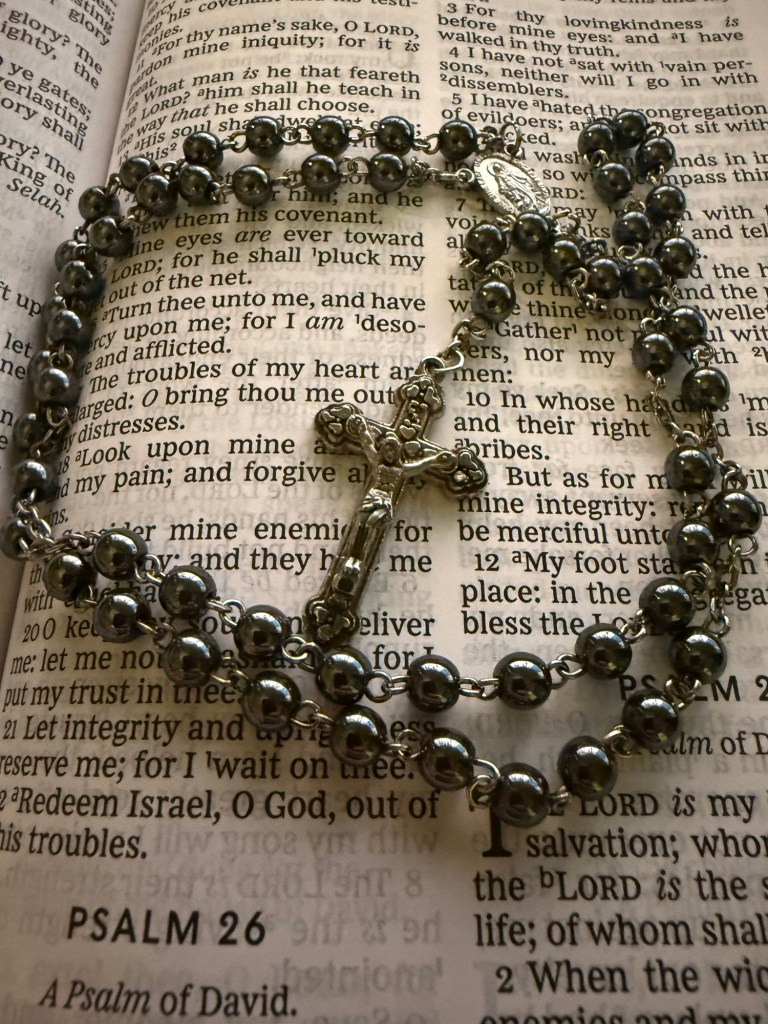
Each decade focuses on a moment in the life, death and resurrection of Christ. This provides the space to meditate on the life of Jesus, through repetition a quiet space for reflection is created.
The rhythm of the prayer slows down both mind and body. Any form of prayer can bring a sense of peace and calm. The Rosary is no different.
The Rosary is a traditional form of devotion and provides a structured form of meditation on scripture. It also provides a means of seeking intercession through prayer.
It builds spiritual discipline by encouraging consistent prayer time and scripture-focused meditation. It can be done alone or shared with others. The Rosary is used by many as a personal devotion to help them to gain clarity, grow in faith or feel spiritually grounded.
It has a range of Biblical foundations. As discussed previously the Lords Prayer comes directly from Jesus.
“This, then, is how you should pray: Our Father…” Matthew 6:9–13; Luke 11:2–4
The Hail Mary is drawn from Scripture:
“Hail, full of grace, the Lord is with you.” Luke 1:28
“Blessed are you among women, and blessed is the fruit of your womb.” Luke 1:42
The second half (“Holy Mary, Mother of God, pray for us…”) is a later Christian prayer, but it expresses two biblical truths:
Mary is the mother of Jesus, who is God Incarnate (Luke 1:43; John 1:1,14)
Asking fellow believers (including saints) to pray for us is biblically normal (1 Timothy 2:1; Revelation 5:8)
The Glory Be is a short doxology reflecting many biblical patterns of praise:
“To the King eternal… be honour and glory for ever and ever.” 1 Timothy 1:17
“Glory to the Father and to the Son and to the Holy Spirit” Matthew 28:19
Each mystery is a meditation on events explicitly narrated in Scripture.
Joyful Mysteries:
1. Annunciation — Luke 1:26–38
2. Visitation — Luke 1:39–56
3. Nativity — Luke 2:1–20
4. Presentation — Luke 2:22–38
5. Finding in the Temple — Luke 2:41–52
Sorrowful Mysteries:
1. Agony in the Garden — Matthew 26:36–46
2. Scourging at the Pillar — John 19:1
3. Crowning with Thorns — Matthew 27:27–31
4. Carrying the Cross — John 19:17
5. Crucifixion — Luke 23:33–46
Glorious Mysteries:
1. Resurrection — Matthew 28:1–10
2. Ascension — Acts 1:6–11
3. Descent of the Holy Spirit — Acts 2:1–4
4. Assumption — implicit (e.g., Revelation 12); taught by Christian tradition
5. Coronation of Mary — symbolic biblical imagery (Revelation 12:1; Psalm 45)
Luminous Mysteries:(added by John Paul II)
1. Baptism of Jesus — Matthew 3:13–17
2. Wedding at Cana — John 2:1–11
3. Proclamation of the Kingdom — Mark 1:14–15
4. Transfiguration — Matthew 17:1–8
5. Institution of the Eucharist — Luke 22:14–20
The Rosary is repetition of biblical prayers, with the purpose of meditating on biblical scenes. In order to grow in biblical virtue. The beads simply act as a structure to keep the mind focused. You can use knots in a cord, your fingers, tiles on a wall, anything which can focus you.
 Walk with the Word